
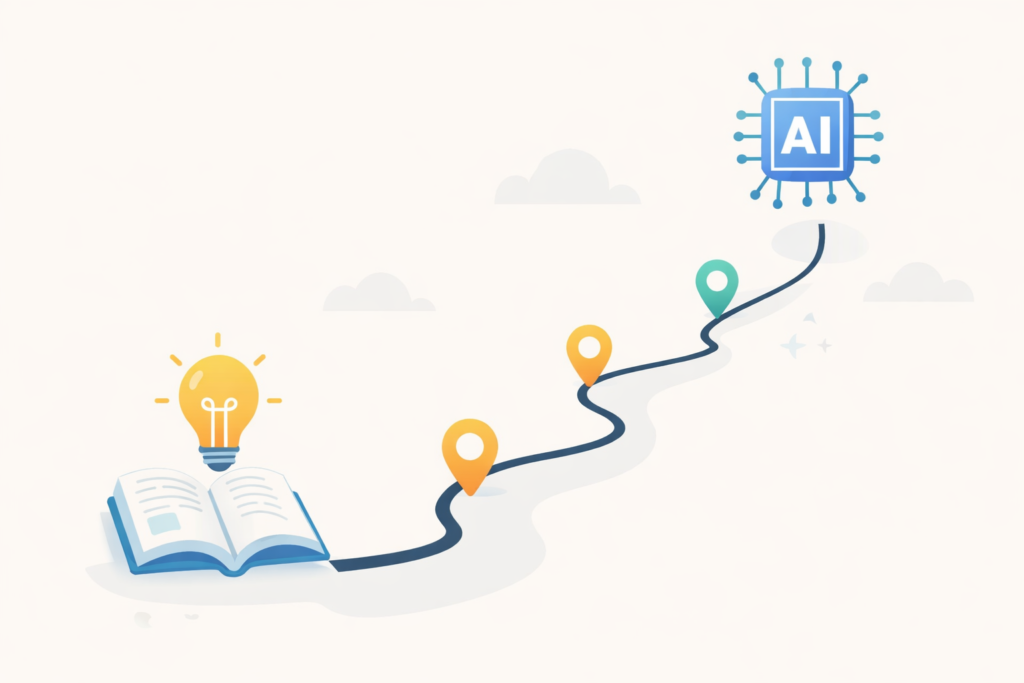

How to Learn AI in 2026: A Simple Roadmap for Beginners (No Jargon)
Artificial Intelligence sounds intimidating to many people. Terms like machine learning, large language models, and prompt engineering can make AI feel like something only engineers or researchers should touch.
The truth is much simpler.
In 2026, learning AI is less about complex mathematics and more about understanding how to use AI effectively. This roadmap breaks AI learning into clear, practical phases, so normal people can learn without feeling overwhelmed.
This guide is for you if:
- You’re curious about AI but don’t know where to start
- You don’t have a technical background
- You want practical understanding, not theory overload
- You want AI to help your work or daily life
Once you understand the basics, tools like Google Gemini can become extremely useful in everyday life.
Phase 1: Foundations — Understanding What AI Really Is
Before learning tools or advanced concepts, it’s important to understand what AI actually does.
At its core:
- AI learns patterns from data
- It predicts the most likely next output
- It does not think or understand like humans
You don’t need to study complex math here. Focus on:
- What AI can do well (text, images, summaries, patterns)
- What it struggles with (context limits, mistakes, bias)
- Why good instructions matter more than intelligence
This phase is about clarity, not depth.
Phase 2: Data — Why AI’s Output Depends on Input
AI is only as good as the information it receives.
In simple terms:
- Better input → better output
- Clear instructions → clearer results
You’ll start noticing:
- Different instructions produce very different responses
- Tone, role, and context matter
- AI behaves differently depending on how you ask
This is where many people realise AI is a tool, not magic.
You don’t need to train models yet — just learn how AI responds to input.
Phase 3: Application — Using AI to Do Real Work
This is where AI becomes genuinely useful.
At this stage, you focus on:
- Writing clearer messages and emails
- Summarising long documents
- Planning tasks and projects
- Learning faster using explanations and examples
You’ll also notice that:
- Step-by-step instructions give better results
- Breaking tasks into smaller requests works better
- AI improves productivity when guided properly
This phase proves you can use AI, not just read about it.
Phase 4: Advanced Concepts — Optional, Not Mandatory
Many AI roadmaps jump too quickly into advanced topics.
The truth is: most people don’t need them.
Advanced areas include:
- Fine-tuning models
- Automation workflows
- Integrations with tools and APIs
- Monitoring AI performance
These are useful if:
- You’re building products
- You’re working in AI-heavy roles
- You want deep customisation
For everyone else, understanding when to stop is just as important as learning more.
What Most Beginners Should Ignore (At First)
You can safely skip:
- Deep mathematical theory
- Model architecture details
- Complex evaluation metrics
- Constantly switching tools
Instead, focus on:
- Consistency
- Practical use cases
- Real problems you want to solve
AI rewards clarity and repetition, not complexity.
How Long Does This Roadmap Take?
Realistically:
- Foundations: 1–2 weeks
- Understanding input/output: 1–2 weeks
- Practical usage: ongoing
- Advanced topics: optional, later
You don’t “finish” learning AI.
You grow with it, step by step.
The Most Important Rule When Learning AI
The order matters.
- First: understand what AI can and can’t do
- Second: learn how input affects output
- Third: apply AI to real tasks
- Fourth: explore advanced ideas only if needed
Skipping steps leads to confusion.
Following them leads to confidence.
Final Thoughts
Learning AI in 2026 doesn’t require a technical background. It requires patience, curiosity, and practical use.
Start small. Use AI daily. Learn through repetition.
This guide will be updated as AI tools and learning approaches continue to evolve.


[…] If you’re new to AI, start with our simple roadmap for learning AI before diving into tools. […]