
While most of the world still relies on paper checks or direct bank deposits for government aid, the Singapore digital voucher system just demonstrated why this city-state is the world’s leading “Smart Nation.”
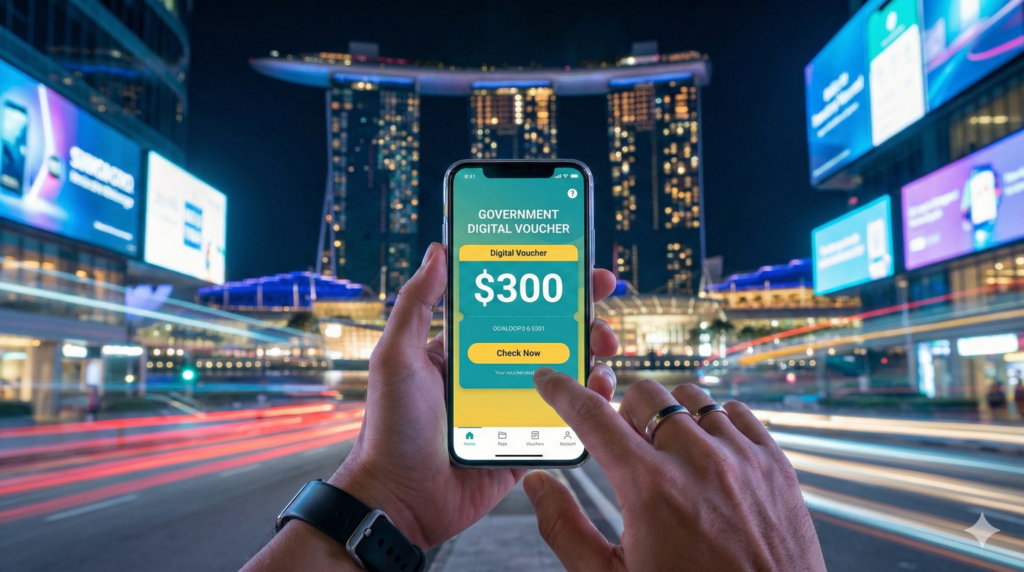
On January 2, 2026, the government launched its latest round of CDC Vouchers, distributing $300 to every local household. But unlike stimulus checks in the US or Europe, there was no mail waiting period and no banking delays. Within seconds, 1.2 million households could claim their money using the Singapore digital voucher system, which operates entirely without a dedicated app.
For our international readers, tech enthusiasts, and future expats, here is a deep dive into the infrastructure of this fascinating government-tech ecosystem.
How the Singapore Digital Voucher System Works
If you are looking at government technology globally, this scheme is a gold standard for UX (User Experience). Here is how the tech stack functions to distribute billions instantly:
1. Digital Identity (Singpass)
Singapore utilizes a National Digital Identity system called Singpass. To interact with the Singapore digital voucher system, one member of the household simply logs in via Singpass. There are no forms to fill out, no manual identity verification, and no waiting for approval. The system verifies who you are and where you live instantly against the national database.
2. No App Required (RedeemSG)
Unlike many clumsy government programs that force you to download another app that crashes on launch day, this system runs on RedeemSG, a web-based infrastructure.
- The Claim: Once verified, the user gets a unique URL (link) sent via SMS.
- The Wallet: They click the link to see their digital cash balance in a web browser.
- The Transaction: They show a QR code to the merchant to pay.
It is frictionless, paperless, and incredibly fast.
3. The 2026 Split: UI in Action
For the January 2026 launch, the $300 is split digitally within the interface:
- $150 for Supermarkets (Big chains like NTUC FairPrice).
- $150 for Hawkers and Heartlands (Small mom-and-pop shops).
The interface uses color-coding (Teal for Hawkers, Yellow for Supermarkets) to prevent user error—a smart UI choice for a system used by everyone from teenagers to the elderly.
Security Layer: Is it Safe?
One question we often get at [Life In Tech Mode] is about security. How safe is a link sent via SMS?
The Singapore digital voucher system uses a restricted domain (gov.sg) that is fiercely protected. Furthermore, the vouchers are “programmable money.” They are not cash in a bank account; they are digital tokens that can only be redeemed by registered merchants with a verified commercial app. Even if someone stole your link, they couldn’t “cash out” the money to a bank account—they could only spend it on groceries, making fraud much less attractive than credit card theft.
Visiting Singapore? What Travelers Need to Know
If you are reading this from the US, UK, or elsewhere, you might be wondering: “Can I use the Singapore digital voucher system?”
The short answer: No. CDC Vouchers are strictly for Singaporean households.
The better answer: While you don’t get the free vouchers, you do need to be prepared for Singapore’s highly digital environment. Cash is disappearing fast. If you are planning a trip or a move here in 2026, here is your “Tech Survival Kit.”
1. You Need Data (Everywhere)
Singapore’s ecosystem relies on scanning QR codes for everything—menus, payments, and entry tickets. You cannot survive here on “Wi-Fi hopping.”
- Recommendation: Don’t pay expensive roaming fees. Use an eSIM to get data instantly upon landing.
- Editor’s Pick: [suspicious link removed] (Reliable 5G coverage in Singapore).
2. The Payment Landscape (SGQR)
Since you can’t use the Singapore digital voucher system, you need the next best thing. Singapore uses a unified QR code standard called SGQR. You will see a single QR code on a merchant’s table that accepts multiple payment apps.
- Pro Tip: Download Grab (the local Uber equivalent) and set up GrabPay. It is the closest a foreigner can get to the local digital wallet experience.
- Save Money: Avoid bad exchange rates on your credit card. Use a multi-currency card like Wise or Revolut to pay like a local.
Comparison: US Stimulus vs. Singapore Digital Voucher System
For our tech-savvy readers, here is a comparison of how different governments handle mass payouts:
| Feature | US/Global Standard | Singapore Digital Voucher System |
| Distribution | Paper Check / Direct Deposit | Unique Web Link (SMS) |
| Speed | Days to Weeks | Instant (On Launch Day) |
| Medium | Cash in Bank | Digital QR Vouchers |
| Goal | General Spending | Targeted Local Economy Boost |
| Tech Requirement | Bank Account | Smartphone + Data Plan |
The Verdict: A Glimpse into the Future
The Singapore digital voucher system is more than just free money; it is a proof-of-concept for the future of programmable currency. It demonstrates how a government can inject liquidity into a specific part of the economy (local hawkers) instantly, with zero distribution cost.
For the rest of the world, it is a case study in efficiency. For those of you heading to Singapore, it is a reminder: Bring a charged smartphone, or you’ll be left behind.
Read Next: Browse our latest Reviews.