
No-code app builders have completely changed how apps are created in 2026. Today, anyone can turn ideas into apps without writing complex code, thanks to powerful no-code and low-code platforms designed for beginners, startups, and businesses.
Building an app no longer requires years of coding experience or a large development team. Thanks to no-code and low-code platforms, anyone—from solo founders to enterprise teams—can transform ideas into fully functional web or mobile applications faster than ever.
Whether you want to launch a startup MVP, automate internal tools, or create client-facing apps, these platforms make app development accessible, affordable, and scalable.
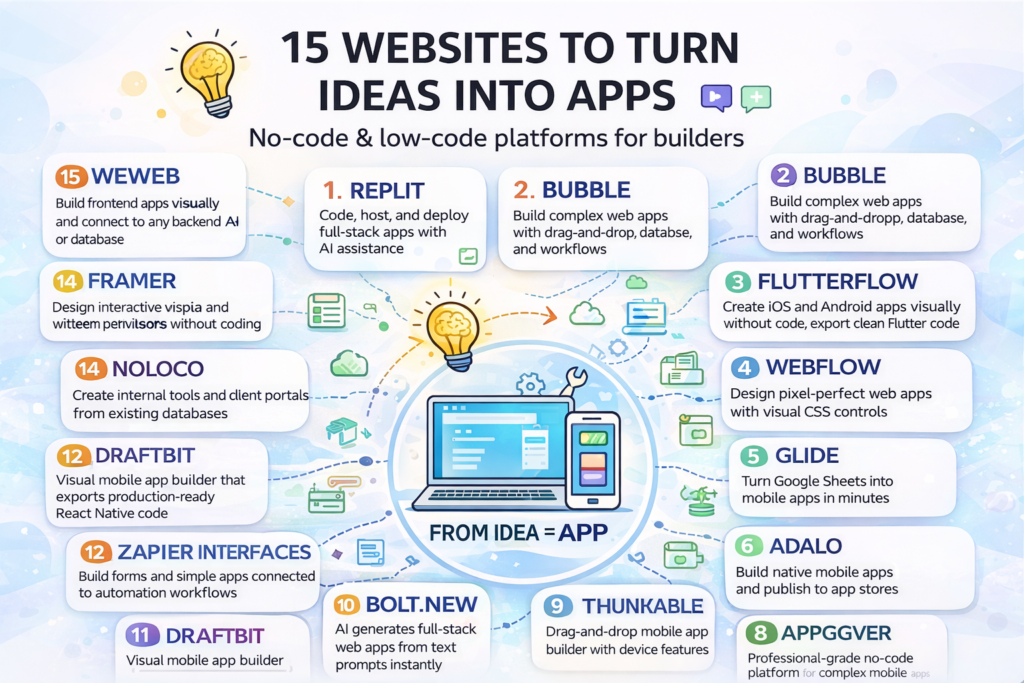
In this guide, we’ll explore 15 powerful no-code and low-code platforms that help you go from idea to app—without writing complex code.
🚀 What Are No-Code and Low-Code Platforms?
No-code platforms allow users to build apps using visual tools like drag-and-drop editors, pre-built components, and workflows—without coding.
Low-code platforms offer similar visual builders but also allow developers to extend functionality using custom code when needed.
👉 Together, they dramatically reduce development time and cost.
If you’re new to this space, check our beginner guide on how no-code tools are reshaping software development.
🔧 15 Best Platforms to Turn Ideas Into Apps
1. Replit
Best for AI-assisted coding
Replit lets you code, host, and deploy full-stack apps directly from your browser with built-in AI assistance.
2. Bubble
Best for complex web apps
Bubble enables powerful workflows, database logic, and scalable web apps using drag-and-drop tools.
3. FlutterFlow
Best for cross-platform mobile apps
FlutterFlow allows you to build iOS and Android apps visually and export clean Flutter code.
4. Webflow
Best for pixel-perfect web apps
Webflow combines design freedom with CMS and logic controls for professional websites and web apps.
5. Glide
Best for fast MVPs
Glide turns Google Sheets or Airtable into functional apps in minutes.
6. Adalo
Best for native mobile apps
Adalo helps you build and publish native apps with custom databases.
7. Softr
Best for portals & membership sites
Softr converts Airtable data into client portals, directories, and internal tools.
8. AppGyver
Best for enterprise-grade apps
AppGyver offers advanced logic and integrations for scalable business apps.
9. Thunkable
Best for device features
Thunkable supports drag-and-drop mobile app creation with access to sensors, GPS, and cameras.
10. Bolt.new
Best AI app generation
Bolt.new generates full-stack apps from simple text prompts—perfect for rapid prototyping.
11. Draftbit
Best for React Native exports
Draftbit is a visual mobile app builder that exports production-ready React Native code.
12. Zapier Interfaces
Best for automation-powered apps
Zapier Interfaces lets you build forms and apps connected directly to automation workflows.
🔗 https://zapier.com/interfaces
13. Noloco
Best for internal tools
Noloco creates internal tools and dashboards from existing databases.
14. Framer
Best for interactive UI
Framer allows designers to build interactive websites with animations—no coding required.
15. WeWeb
Best frontend builder
WeWeb lets you design frontend apps visually and connect them to any backend or API.
📊 No-Code vs Low-Code: Which Should You Choose?
| Use Case | Best Choice |
|---|---|
| Beginners & solo creators | No-code |
| Startups & MVPs | No-code |
| Complex logic & scaling | Low-code |
| Enterprise customization | Low-code |
🌟 Why No-Code App Builders Are Exploding in 2026
- Faster time to market
- Lower development costs
- AI-assisted workflows
- Reduced dependency on developers
- Perfect for startups & side projects
According to industry reports, over 70% of new applications will be built using no-code or low-code platforms by 2027.
🧩 Final Thoughts
If you have an idea but feel limited by coding skills, no-code app builders are your fastest path forward. From AI-generated apps to enterprise-grade platforms, there’s a tool for every use case.
The key is choosing the platform that aligns with your goals—whether it’s speed, scalability, or customization.